
Every time I am tempted to make things a little simpler for myself and mow an area that only has one or two native plants in it, something shows up to remind me why I practice “precision mowing” and push the mower around a whole bunch of things:
A couple of weeks ago, I was mowing in the front yard as the sun was going down. I was running out of time. There was a Vernonia plant (common name: ironweed) that I know will grow tall and get gorgeous deep purple flowers in August and September. But I have more than 100 of those naturally growing in the yard. I was tired. I thought, maybe I’ll just mow this one. It won’t matter. As I passed by next to it, mowing the row of grass beside it, I looked at it and (of course) saw a little caterpillar living on it. It will become a Tiger moth. I say “it will” because I did not mow it down.
In the backyard last week I was preparing for a garden party and mowing around the edges of my big wildflower beds. As native plants will do, they have been spreading beyond the edges of the beds. I was tempted to mow down the common milkweed. I have lots of it. It was outside its area. It’s not really all that pretty. I thought partygoers might step on it anyway. But I left it there. And no one stepped on it. And I kept mowing around it and last night I came outside and saw THREE caterpillars on the smallest milkweed plant that is growing outside the edges of the wildflower bed.
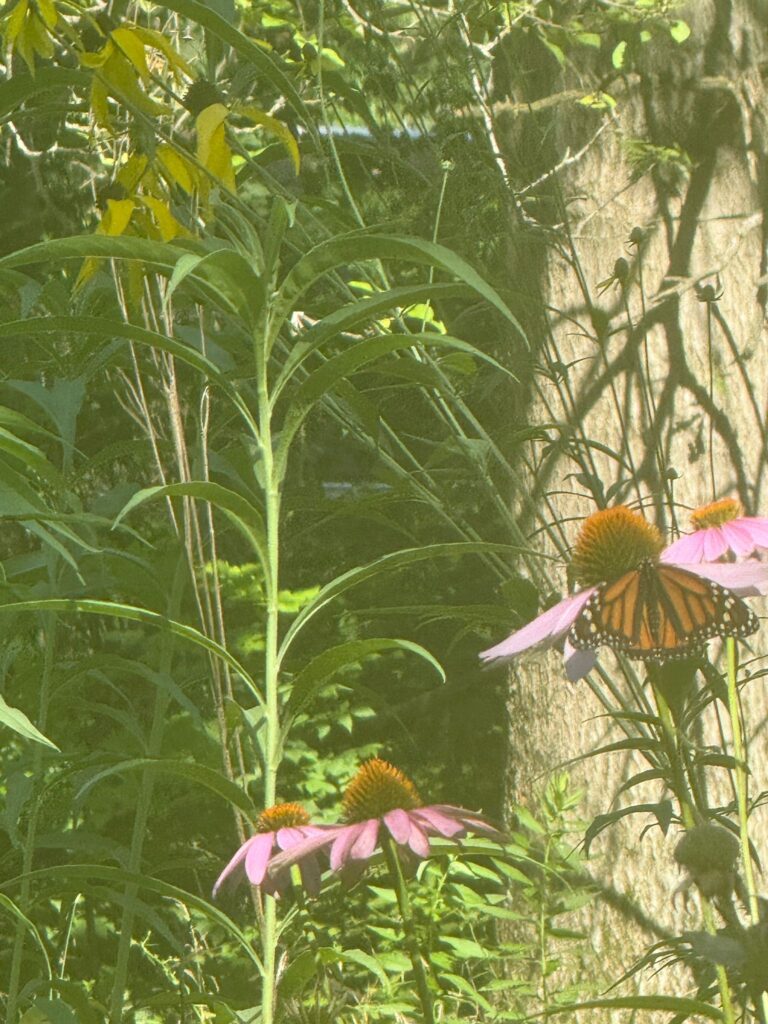
I also recently saw a monarch flitting around my flowers. Most people have heard that monarch butterflies, which are pretty much the icon of butterflies and what everyone thinks of when someone says the word “butterfly,” are in serious decline. They migrate a very long way each year, and have a hard life as it is. But in order to reproduce, they must have a plant called milkweed. Milkweed, at least Common Milkweed, has the misfortune of being a fairly coarse plant with big thick leaves. It gets flowers but they don’t last too long and they aren’t symmetrical. They are nothing that anyone would pick out for their mother at the nursery to plant on Mother’s Day. So people cut them down. Lots and lots of them. Until there were hardly any left. It’s very important to protect milkweed. And to surround it with other native flowers the butterflies can feed on, like this Purple Coneflower in the photo.