
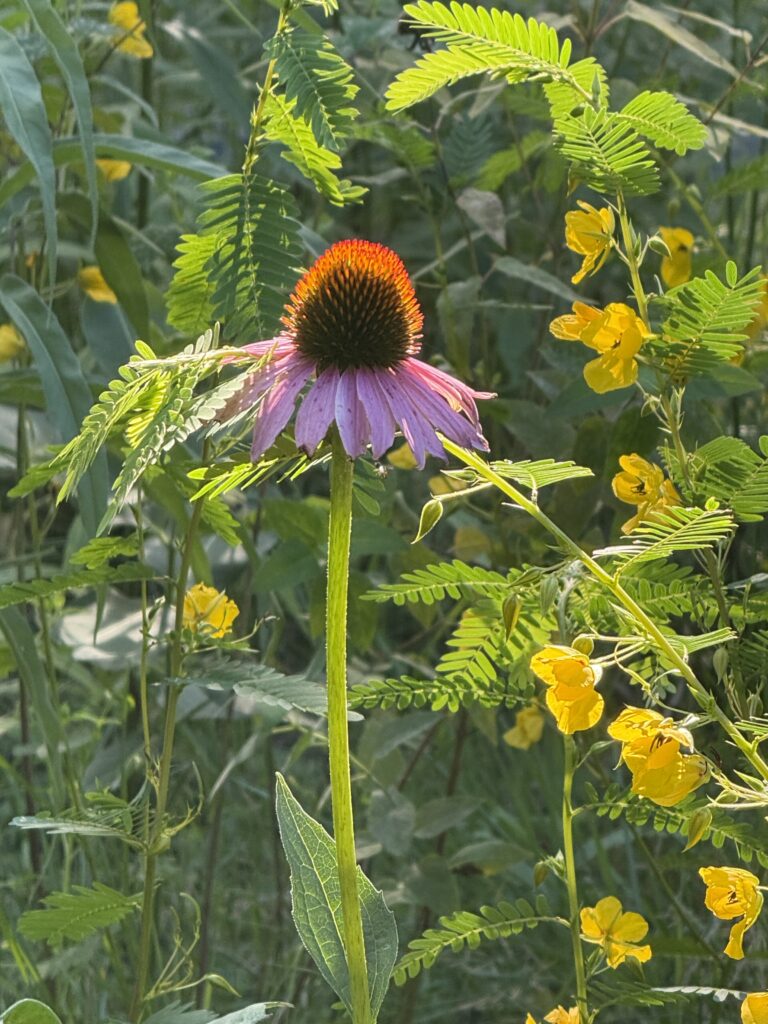
At the start, I was only trying to defend my own plants from a nuisance citation and an impending “forced mowing” by my township, because they had received two complaints about tall grass at my home in 2024. I did lots of work giving tours to various officials, talking to legal experts, and spending the remaining time trying to make the yard a little prettier, even though pretty can sometimes be the enemy of biodiversity. The nuisance complaint was ultimately withdrawn after my efforts to increase signage, to share my plans in the form of a formal landscape plan, and many many additional plantings of native plants, both from seeds and from “plugs” (small plants raised from seed and purchased or given to me by friends).
Part of my goal was always to raise awareness and try to make it easier for others to also restore their yards from mowed “dead zones” back to their natural state. I even had a goal to support my township in creating a Managed Natural Landscape ordinance, so that they would have a framework for people whose yards didn’t fit into the typical 8-inch or shorter grass and defined flower beds described in the International Property Maintenance Code that the township uses to govern code enforcement.
The township trustees did invest time and resources into creating a policy, but — at least the first draft — does more to DIScourage native plantings than to encourage it.
They took many of the activities that I performed in self-defense, under threat of commercial mowers coming to mow everything down and put a tax lien on my house to pay for it, and make them the law for everyone. The draft policy says homeowners who wish to naturalize their lawns must only do so on 30% of their property, must have a sign (and apply for and pay for a sign permit, which requires fairly advanced software to complete the required schematics), must submit a landscape plan (again, special software or a professional consultant), must mow it every year, must contain the planted areas with a border that is not a mown grass border but something more substantial (and costly), and must take a class annually and pay an annual fee. If their lawn does not comply with these various requirements, they will be fined $50 per day.
This was not what I had in mind when I suggested a Managed Natural Landscape policy. There are hearings Aug. 5 and Aug. 19 at the Blendon Township Senior Center at 6:30pm if you care to speak or hear what others are saying. Speakers are limited to three minutes each. I plan to explain some of the practical considerations that make this difficult for the average person.
Update: The public outcry was loud and nearly unanimous. 1,200 people signed an online petition. Nearly 100 people attended a public hearing, packing the room and overflowing into the lobby. 30 speakers gave testimony on the importance of allowing residents to garden freely. Channel 4, Channel 10 and the Columbus Dispatch ran major stories.
As a result, the township cancelled the second scheduled public hearing and agreed to go back to the drawing board.